
Music Sync
How a chart’s patterns fit a song’s rhythms and intensity.
If you want to quickly translate some of your charting skills from another rhythm game to XDRV, this passage should help with that. This QUICKSTART is composed of brief write-ups on each component of charting for XDRV, giving more time to the more unique elements.
The general means of charting notes to songs in any VSRG can be transferred over to XDRV with relative ease. Typically, a quality chart in XDRV fulfills three principles:
Music Sync
How a chart’s patterns fit a song’s rhythms and intensity.
Visual Appeal
How a chart’s patterns look, including clarity and balance.
Fun
How a chart plays on all intended playstyles.
While some of these qualities can be somewhat subjective, there are some general practices that charters can follow to achieve all principles. An important factor to consider when charting for XDRV is hand balance. It is important to ensure that the number of tap notes, hold notes, and gears is roughly equivalent for both hands. Otherwise, your chart may favor one hand dominance over another.
Despite the playfield of XDRV being split into a left and right track, it is better to think of this space as continuous rather than isolated. For the majority of patterns, you should place notes across all 6 lanes. Meaningful exceptions can be made in which track or lane usage is restricted. Groupings of notes restricted to the left or right track can result in more technical patterns. Alternatively, limiting the number of lanes used for a section’s patterns can be great for texture and difficulty control. The most common lane limits are 1-3-4-6 and 2-3-4-5, each resulting in 4K-style gameplay.
For both difficulty control and pacing, syncopation is a common tool used in XDRV charting. Most charts include syncopation by omitting notes where a song’s rhythm is of the least emphasis. In XDRV, it is also valuable to chart only the most present elements of a song. With some exceptions, the most that charters can chart before a section feels overcharted is two different parts of a composition (ie. lead synth + percussion).
If you are familiar with the essential patterns of most VSRGs, then you will be largely familiar with the patterns present in many XDRV charts. Mixing classic VSRG patterns and more original patterns is a great way to make patterns that feels unique, expressive, and in-line with base-game charting.
Hold note usage in XDRV operates similarly to hold note usage in other VSRGs. However, one key difference is that XDRV’s hold notes do not have release timing. This permits charters to use releases in a more expressive manner without meaningfully increasing the chart’s difficulty.
Gears are one of XDRV’s most creative gimmicks, but they have a number of limitations that add character to their use. First, all gears are composed of a head and a tail, requiring two separate inputs. In turn, each gear placed should correspond to two sounds. As with tap and hold notes, gears also need to be properly balanced between left and right.
Controller players have additional limitations when it comes to hitting gears. On a controller, players need some time to move between the inner lane note (3-4) and the gear note, as both inputs are hit by the thumbs. In turn, charters should give controller players ample time to make the movement. Otherwise, chart difficulty can vary by playstyle. Some charts purposefully lean into the requirement for movement between gear and inner lane to create dynamic patterns. Additionally, as controller players must input a flick rather than a tap for gears, trills and jacks composed of gears can be more exhausting to hit, especially at higher speeds.
Gear patterns can be made relatively easily by incorporating them into patterns lacking gears. Choosing to use gears or not use gears in one section of a chart can result in interesting effects on texture and gameplay.
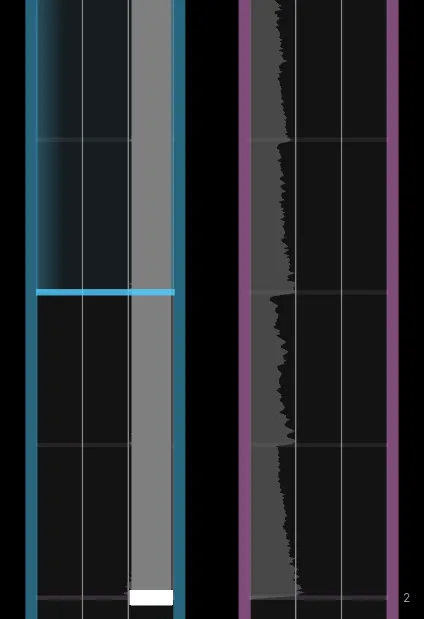
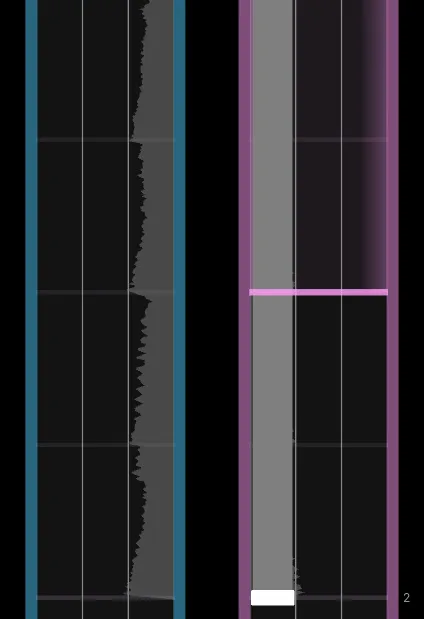
A crossgear is a combination of notes where one thumb is unable to hit a gear on its side due to being occupied with an inner lane note, requiring the thumb from the opposite hand to reach across and hit the gear.
 |  |
|---|---|
| Left Crossgear | Right Crossgear |
Crossgears can be used in a number of different ways. Typically, controller players need some amount of time to prepare for and/or make the movement to hit crossgears. Crossgears are best implemented when an inner-lane hold note starts before the gear and ends after it. If indicated via note placement, crossgears where an inner lane and gear input are required simultaneously can also be fun, though careful indication is required to avoid unreasonably fast movements.
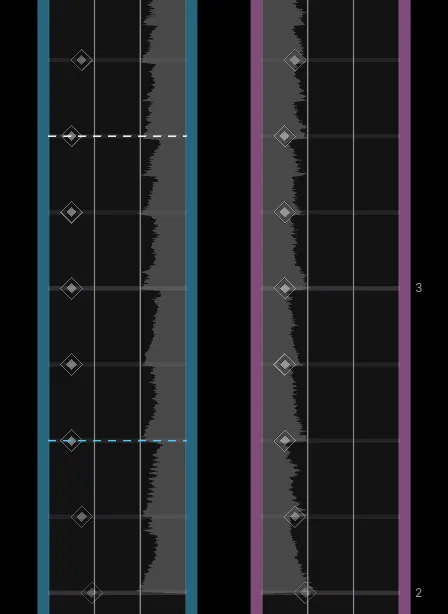
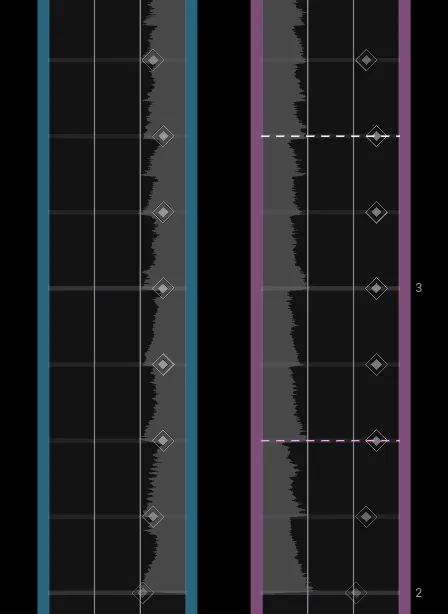
Drifts are a highly unique and stylized gimmick to XDRV. Unlike other inputs in the game, they do not require exact timing. Rather, the player must be in the drifting state prior to the region’s start. Additionally, drifts do not contribute their own score or EX. Instead, they amplify the score and EX given by other notes or gears in the duration of the drift (start beat inclusive, end beat exclusive). If no combo is earned during the duration of a drift, then the player does not need to be in the drift state for that duration.
 |  |
|---|---|
| Left Drift | Right Drift |
Drifts are best used to represent sustained or dense sounds in the music that would not be reasonably represented with taps, holds, or gears. This can include sustained harmonies, short synth movements, effects, risers, and percussion loops. While there is a lot of potential for expressiveness with drifts, there also some technical rules that charters should follow for the drifts to function properly:
Creating lower difficulty charts is a great way to make you chart sets more accessible to a larger number of players. The goal with lower difficulties is slightly different than upper difficulties, however. For BEGINNER charts, patterning is mostly based on the idea that the player is limited in their ability to read and hit patterns. In turn, charters aim to create simple patterns that support the development of these skills. For NORMAL charts, patterning falls somewhere in between simplicity and representativeness, as players are no longer as restricted in skill.
While the types of difficulties can be split into certain goals, nuances exist across the numerical ratings given to each chart.
Beginner (BG) Charting
Typical Difficulty Range: 1-5
Normal (NM) Charting
Typical Difficulty Range: 6-9
Lower Hyper (HY) Charting
Typical Difficulty Range: 10-13
Upper Hyper & Extreme (EX) Charting
Typical Difficulty Range: 14-15
This covers much of XDRV’s charting style. If you would like to see a more in-depth analysis of any of XDRV’s note or pattern types, you might want to consult one of the more in-depth articles of the Patterns section. Regardless, the process of creating charts for XDRV will come easier to you as you spend more time working on it.